
There's a task that every research team does and nobody enjoys: link testing.
After a survey is programmed and before it goes to field, someone has to click through every path a respondent could take. Every skip condition. Every pipe. Every display logic rule. Every quota redirect. Every termination point.
For a simple survey, this takes an hour or two. For a complex tracker with layered routing, it can take a full day. And if the spec changes after testing — which it always does — the whole process starts over.
Link testing is the QA step that stands between a programmed survey and a fielded one. It's also the step most likely to be rushed, abbreviated, or skipped under deadline pressure.
The cost of skipping QA
The consequences of a missed routing error aren't theoretical. They're concrete and expensive.
During fielding: Respondents hit dead ends, see questions they shouldn't, or loop endlessly. Completion rates tank. Panel providers flag the survey. Field stops while the team debugs.
After fielding: Data arrives with contamination — respondents who answered questions they should have been routed past, brand evaluations for brands they didn't select, satisfaction scores from people who were supposed to be screened out. This data looks clean in a spreadsheet. It isn't.
After delivery: A client makes decisions based on data they trust. Months later, an analyst notices an anomaly, traces it back to a routing error, and the entire study is called into question. Not just the one question — the whole study, because if one routing condition was wrong, how many others were?
Greenbook's reporting on data quality challenges consistently ranks quality assurance as a top industry concern. The 2025 GRIT report identified sample quality as a leading anxiety. But sample quality is downstream of survey quality — if the survey itself routes incorrectly, no amount of sample rigor can save the data.
Why manual testing fails
Manual link testing has a fundamental problem: it doesn't scale with survey complexity.
A survey with 5 screening questions, each with 3-4 response options that affect routing, produces dozens of possible paths. Add quota controls, piped loops, and conditional displays, and the combinatorial space explodes.
No human tester walks every path. They walk the main paths — the "happy paths" — and a handful of edge cases they can think of. The rest is assumed to work.
This is equivalent to testing software by trying a few inputs and hoping the rest work. It's the reason software engineering moved to automated testing decades ago. Research hasn't made that transition yet.
The other problem is time. Manual testing happens at the end of the programming cycle, when deadline pressure is highest. If testing reveals errors, fixing them requires another round of testing, which pushes the field date. This creates a perverse incentive to test less thoroughly when the stakes are highest.
What automated link testing looks like
Automated survey testing follows the same principles as automated software testing:
1. Infer test scenarios from the survey logic
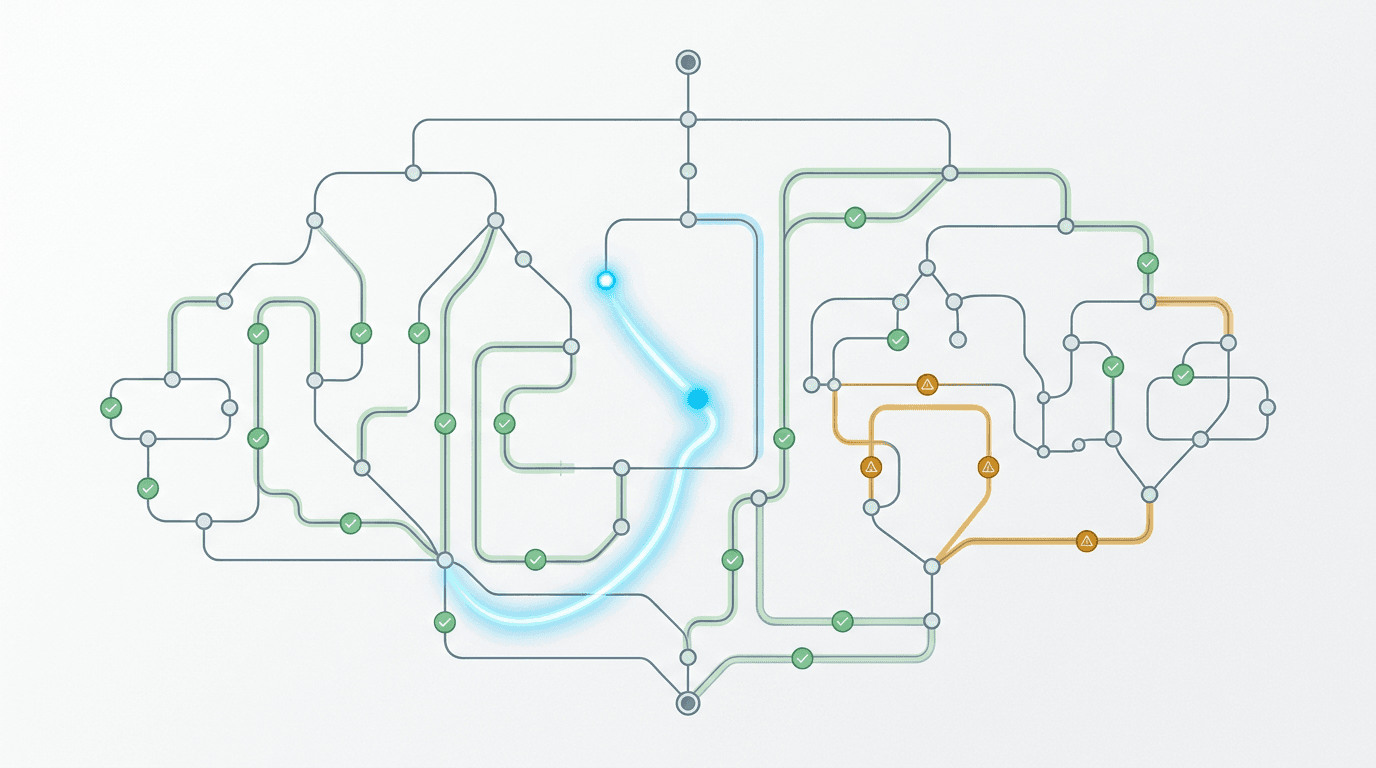
The survey's routing structure is a map. Every skip condition, every display rule, every quota gate defines a branch. An automated system can read this map and generate a comprehensive set of test paths — not just the obvious ones, but the edge cases that a human would miss.
"Show Q12 only if Q3 = Brand A AND Q7 > 3 AND Q10 ≠ 'None of the above'" — that's a specific path that needs testing. An automated system identifies it; a human tester might not.
2. Execute paths end-to-end
For each test scenario, an agent walks the survey the way a respondent would — selecting answers, submitting pages, following the routing. It records what it sees at each step: which questions appeared, what options were available, where it was routed.
3. Compare expected vs. actual behavior
The test framework knows what should happen on each path (from the survey logic) and what actually happens (from the execution). Discrepancies are flagged: "Q12 should appear for Brand A respondents who rated > 3, but it appeared for all respondents."
4. Generate a coverage report
After running all paths, the system reports which percentage of routing conditions were tested, which paths were clean, and which had issues. This gives the researcher a concrete quality metric — not "we tested it" but "we tested 94% of paths and found 3 issues."
5. Create regression tests
The best part: approved test runs become regression tests. When the spec changes and the survey is reprogrammed, the existing tests run again automatically to verify that nothing broke.
This is the same principle as software regression testing. It converts manual QA effort into a durable asset that gets more valuable over time.
The shift from "did we test it" to "how well did we test it"
Manual testing is binary: either someone clicked through the survey or they didn't. There's no metric for thoroughness. A senior programmer who tested 80% of paths and a junior who tested 20% of paths both report "link testing complete."
Automated testing introduces coverage as a measurable quantity. When you can say "this survey has 97% path coverage with zero discrepancies," you're making a quality claim that's verifiable. When a client asks "how do you ensure quality," you have a number, not a promise.
The workflow integration
Automated link testing is most powerful when it's integrated into the programming workflow, not tacked on afterward:
- Survey is programmed (manually or by AI)
- Validation runs automatically — logic checks, reference verification, pipe resolution
- Test scenarios are generated from the validated survey logic
- Tests execute and produce a coverage report
- Researcher reviews the report and addresses any flagged issues
- Approved tests persist as regression tests for future revisions
This converts QA from a bottleneck at the end of the cycle to a continuous quality signal throughout the cycle.
Why now
Two trends make automated link testing viable in a way it wasn't five years ago:
AI can understand survey semantics. Generating meaningful test scenarios requires understanding what a survey is trying to measure, not just what buttons to click. Modern language models can parse routing logic and generate respondent profiles that exercise specific paths.
Browser automation is mature. Tools like Playwright make it straightforward to programmatically walk through a web survey, interact with form elements, and record the results. The infrastructure for end-to-end testing exists — it just hasn't been applied to survey research at scale.
The gap isn't technical. It's cultural. Research teams haven't thought of survey QA as a testable, automatable process. Once they do, the tools are ready.
Automated link testing is on Questra's roadmap. We're building AI-powered test generation that infers scenarios from survey logic, executes them, and converts approved runs into regression tests. If you want to know when it's ready, sign up and we'll let you know.