
There's a tempting narrative in AI: full autonomy. The machine handles everything. You press a button, walk away, and come back to a finished product.
For survey research, that narrative is dangerous.
A survey that goes to field with a broken routing condition doesn't just waste money. It collects data that looks valid but isn't — responses from people who should have been screened out, brand evaluations piped to the wrong stimulus, satisfaction scores from a segment that never used the product.
The cost of a bad survey isn't the refield. It's the decisions made on corrupted data before anyone notices.
Why full autonomy is the wrong goal
The argument for unsupervised AI is efficiency. And it's true — removing human checkpoints makes things faster. It also removes the safety net.
McKinsey's State of AI research found a stark divide: 64% of organizations classified as "AI high performers" have rigorously designed oversight processes. Among general AI users, that number is 23%.
The difference between AI that creates value and AI that creates risk isn't the model. It's the process around it.
Forsta makes the same case in their 2026 workflow analysis: "Accountability doesn't shift to the machine. Whether research is conducted for a client or used to inform internal decisions, responsibility still sits with people."
When something goes wrong in a survey, the client doesn't blame the AI. They blame the team that fielded it.
What supervision actually looks like
"Human-in-the-loop" can mean anything from "a person clicks Approve" to "a person reviews every decision the AI made." The latter is useful. The former is theater.
Meaningful oversight requires the AI to do three things:
1. Show its work
When an AI programs a survey, every decision should be traceable. Why was this question implemented as a matrix grid instead of individual scales? Why does this skip condition reference Q7 and not Q8? Why was this piped text resolved the way it was?
If the researcher can't see the reasoning, they can't evaluate it. And if they can't evaluate it, their approval is meaningless.
2. Flag what it doesn't know
The most important behavior of a supervised AI system isn't what it does confidently — it's what it does when it's uncertain.
Questionnaire specs are ambiguous. "Ask awareness for relevant brands" — which brands are relevant? "Skip to the next section if unqualified" — what defines unqualified? "Rotate the order of these items" — all items, or just the non-anchored ones?
An unsupervised system guesses. A supervised system asks.
Flagging ambiguity isn't a weakness. It's the single most important quality signal in an AI-powered workflow. Every flag is a potential error that was caught before fielding.
3. Validate before presenting
The AI should check its own work before a human ever sees it. Logic validation — do all skip conditions reference existing questions? Do all pipes resolve? Are there orphaned conditions or unreachable questions?
This isn't about perfection. It's about catching the class of errors that are mechanical and verifiable, so human review can focus on the class of errors that require judgment.
The spectrum of automation
Not every decision in survey programming requires the same level of oversight:
Low risk, high automation. Converting a single-select question with four response options into a radio button group. The translation is unambiguous — let the AI handle it.
Medium risk, validate and flag. Implementing skip logic that spans multiple pages and involves compound conditions. The AI should implement it, validate it, and present the logic for human review.
High risk, human decision. Resolving conflicting instructions in a spec, or deciding how to handle a question type that the platform doesn't natively support. The AI should surface the problem and propose options, not choose.
The right system doesn't apply the same level of oversight to every task. It applies more oversight where the consequences of errors are higher.
Why this makes AI more useful, not less
There's a fear that adding checkpoints slows things down and erodes the efficiency gains of automation. The opposite is true.
When researchers trust the system, they adopt it faster and use it for more projects. Trust comes from predictability — the system does what they expect, flags what they need to review, and doesn't surprise them in production.
An AI system that's right 95% of the time and wrong 5% of the time without telling you which is which isn't 95% useful. It's 0% trustworthy, because you have to verify everything anyway.
An AI system that's right 95% of the time and explicitly flags the 5% it's unsure about is genuinely useful. The researcher knows exactly where to focus their attention.
The trust equation
In survey research, the stakes are concrete. A fielded survey with a logic error costs:
- Direct costs: Refielding, respondent incentives, vendor penalties
- Time costs: Days or weeks of delay while the error is found and corrected
- Credibility costs: The stakeholder who used the data before the error was caught
Human oversight isn't overhead. It's insurance — and for most research teams, it's the only thing standing between a good study and an expensive mistake.
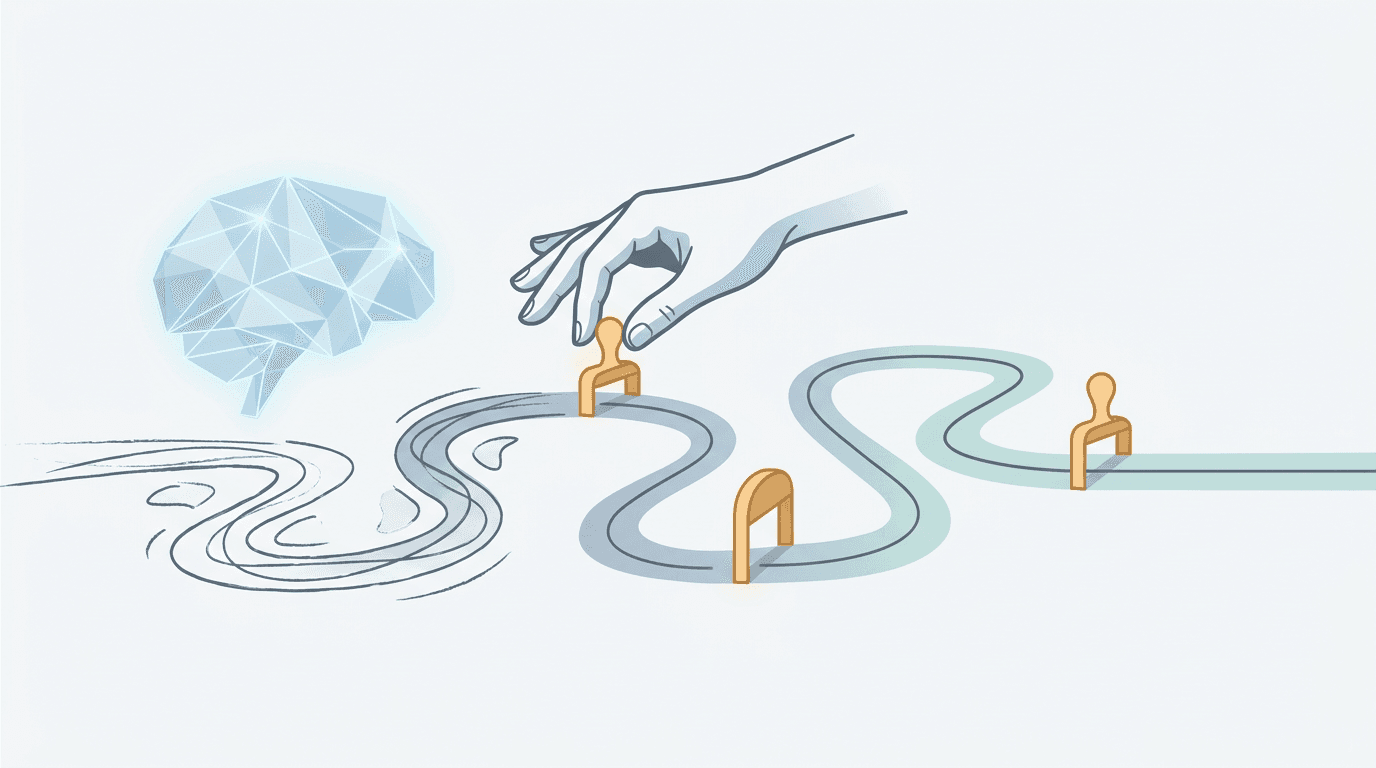
The goal isn't to remove humans from the loop. It's to move them from building to reviewing — from spending 10 hours programming a survey to spending 30 minutes verifying that the AI programmed it correctly.
That's a 20x productivity gain with a stronger quality guarantee. Not despite the oversight. Because of it.
Every survey Questra programs goes through validation before you see it — logic checks, pipe resolution, condition verification, and clear flags for anything the AI couldn't resolve. You review and approve. Try it.